Writing · Mar 7, 2026
7 min read · Product design · Agentic UX
Confidence is the missing layer in AI interfaces
Autonomy should be earned by evidence, bounded by risk, and visible in the interface.

Confidence is not a feeling
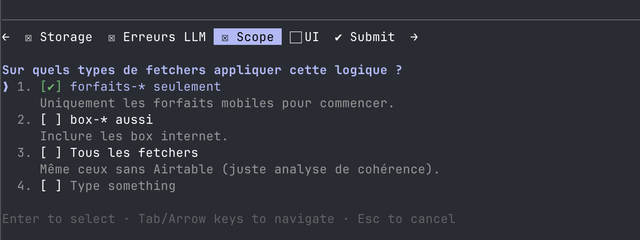
Many AI products use the same interaction loop: generate an answer, offer a few next steps, and ask the user to choose. It feels safe because a person remains in control. It also transfers every small decision back to that person.
The alternative is not unlimited autonomy. It is risk-adjusted autonomy: the system acts when evidence is strong and the consequence is easy to reverse, proposes when ambiguity is manageable, and pauses when the cost of being wrong is high.
The difficult part is that a model saying “I’m confident” is not sufficient evidence. A 2024 study of GPT, LLaMA 2, and Claude found an average 47% error rate among answers the models expressed confidently. Users still relied heavily on those answers, whether or not uncertainty was shown.1
So the product cannot route actions from verbal confidence alone. Confidence has to be a measured system property: grounded in task-specific evaluations, tool results, agreement checks, missing information, and the historical error rate for that exact class of action.
The missing variable is consequence
Even calibrated confidence does not answer the product question by itself. A 5% chance of choosing the wrong icon is not equivalent to a 5% chance of sending the wrong email. The interface needs to evaluate at least four signals:
- Evidence: Is the answer grounded in current, relevant sources?
- Ambiguity: Is the user’s intent specific enough to act on?
- Impact: What happens if the action is wrong?
- Reversibility: Can the user inspect and undo it?
NIST’s AI Risk Management Framework makes the same distinction operationally: knowledge limits, human oversight, and threshold values should be defined and measured for the use case, not assumed from a general model score.2
Autonomy = evidence × reversibility
Escalation = ambiguity × impact
A four-state confidence layer
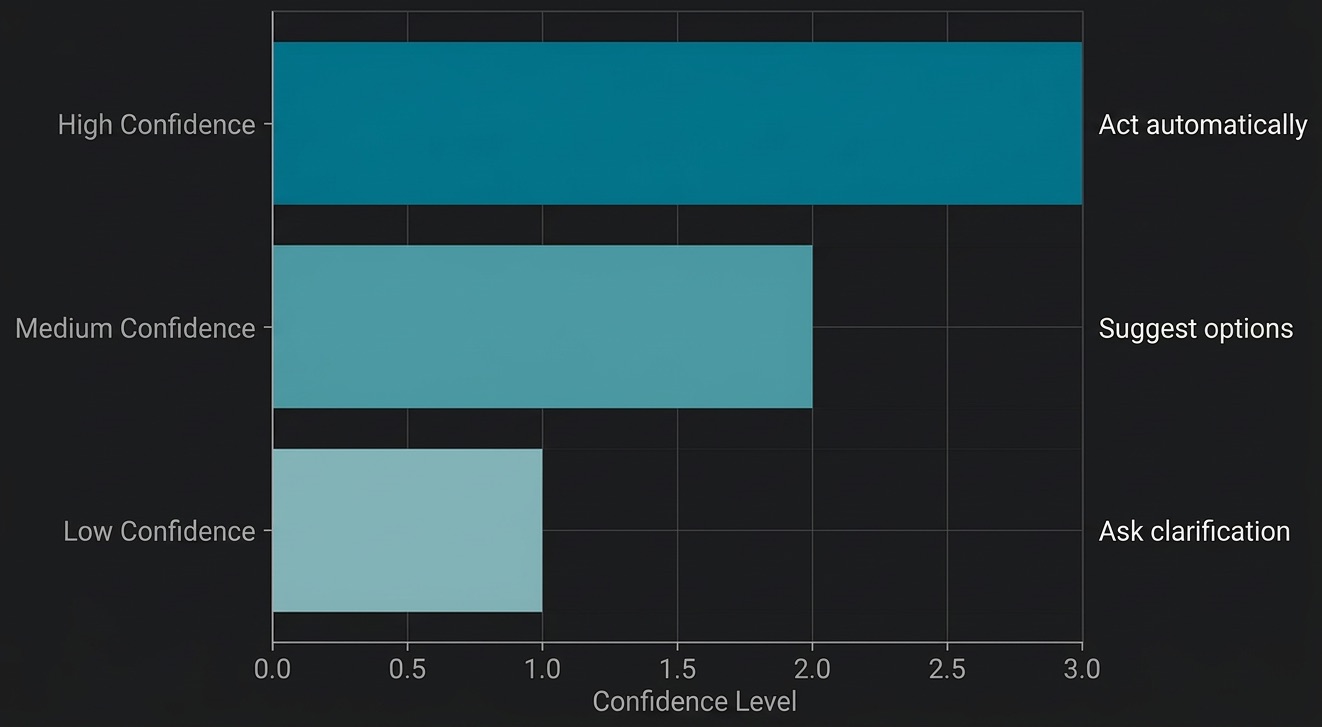
Act
Use when evidence is strong, impact is low, and the change is reversible. Regenerating local types after a schema change can happen automatically, with a concise activity record and undo.
Propose
Use when several valid paths exist. The agent should recommend one option and explain the deciding signal, instead of presenting an unranked menu.
- Recommended action
- Evidence used
- Expected effect
- Alternative path
Ask
Use when one missing fact would materially change the result. Ask one targeted question, state why it matters, and preserve the work already completed.
Stop
Use when the action is irreversible, outside policy, or too consequential for inferred consent. This is a boundary, not a confidence level.
What deployed systems reveal
Confirmation data from ChatGPT agent shows why this boundary matters. OpenAI reports 91.0% confirmation recall across relevant actions, and between 99.9% and 100% for tested critical categories such as high-stakes communications, financial transactions, and permission edits.3 The goal is not to ask before everything. It is to catch the small set of actions where a miss carries real cost.
That suggests a better design target than “fewer confirmations”: maximize useful work completed without intervention while maintaining near-perfect escalation on consequential actions.
Measure the policy, not the prompt
A confidence layer should ship with an evaluation set built from real tasks. For every action class, teams can track:
- Calibration: when the system predicts 80% reliability, is it right about eight times out of ten?
- Coverage: what share of work can it complete without escalation?
- Critical miss rate: how often does it act when it should have stopped?
- False interruption rate: how often does it ask when it could safely proceed?
- Recovery cost: how much effort does an incorrect action take to detect and undo?
Google’s study of 76 software engineers found signs of automation complacency and increasing reliance on AI over the course of a programming task.4 That is why “human in the loop” is not enough by itself. A person who is interrupted too often learns to approve automatically. Oversight has to be scarce enough to remain meaningful.
Good agents act—and leave evidence
The mature interaction pattern is not silent automation. It is autonomous execution with a legible trail: what changed, why the system believed it was safe, what source or rule it used, and how to reverse it.
Confidence belongs in the interface, but not as a decorative percentage. It should determine the mode of interaction and be constrained by consequence. The result is an agent that asks fewer questions because it can justify more actions—and knows exactly when it must stop.
Sources
- Zhou et al., “Relying on the Unreliable” (2024) — model uncertainty and user reliance.
- NIST AI RMF Playbook: Measure — oversight, uncertainty, thresholds, and evaluation.
- OpenAI, ChatGPT agent user confirmations — confirmation recall evaluations.
- Qian and Wexler, “Take it, Leave it, or Fix it” (IUI 2024) — a study of 76 software engineers.
First published on Substack.