Selection Is the Craft: Notion and the Culture of Making
Nov 2026What's documented about craft at Notion, what isn't, and how cheap variations change what craft means.
A note on the topic
I originally wanted to write about "Notion's craft team." I couldn't find any public source confirming a team formally called that. What I did find is craft as a documented company value and a hiring signal, so this post is about that, and I'd rather say so plainly than invent an org chart.
What's true right now
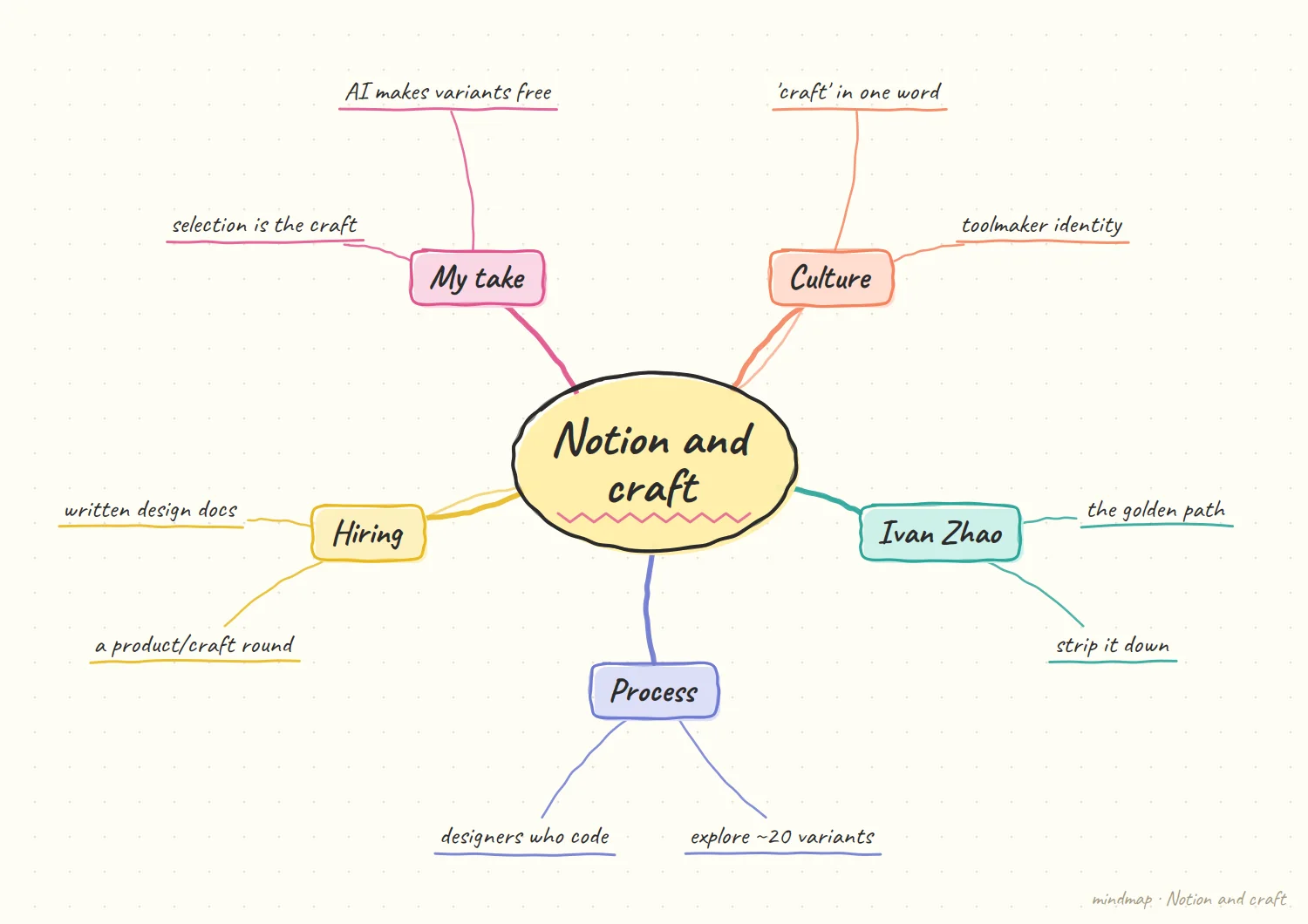
Employees reach for the same word. On Built In's culture pages, a Notion engineer describes the culture in one word, and the word is craft, explaining that it shows up in both the product and the workplace, including employee-led workshops and careful handovers when a product area changes teams. Another Built In piece, Why 'Craft' Defines Notion's Culture, is built around the same idea.
The founder's approach is documented. A profile of CEO and designer co-founder Ivan Zhao describes him as skeptical of clever design and consistently pushing the team to strip things down and focus on the golden path, the main flow that most people will take. The same piece says the team optimizes for exploration over up-front polish: designers will copy and paste a UI many different ways to see what falls out, and the right answer eventually becomes obvious. It also notes Zhao has called Douglas Engelbart Notion's patron saint, and draws on history from Alan Kay to mid-century furniture.
Hiring reflects it. Notion job postings ask for creative toolmakers who want to be the best in their craft, and designer postings say they love hiring designers who can code to reduce handoff cost, polishing features directly in the codebase. A third-party interview guide describes a distinctive product-and-craft round and says Notion treats writing as first-class engineering output, though that's a secondary source, so I'd hold it loosely.
What I notice
The most interesting detail is the process: copy a UI twenty ways and see what falls out. That method assumes making variations is cheap enough to do twenty times. With AI, it can be two hundred. The production part of exploration is nearly free.
What a ranking exercise might look like
Illustrative: my own sketch, not a sourced fact.
Twelve versions, one screen. Picture a settings screen generated twelve ways. Some are denser, some friendlier, some hide the main action. The exercise is not to pick the prettiest. It is to find the one closest to the golden path and say what each of the others gives up to get there. If the answers are muddled, that is information too: it means the options differ less than they look, or the goal was never clear.
The reason is the answer. A bare ranking tells me little. "This one, because the main flow takes one fewer step" tells me the person understands the product. That sentence is also the part a teammate can disagree with, which is what makes taste something a team can work on. That makes the reasoning the skill worth practising, and it is also what could be taught to someone newer to the team.
My hypothesis
This section is my opinion, not a sourced fact.
When variations become free, craft shifts almost entirely from making to selecting, and the skill that matters is knowing which of two hundred options is right and being able to say why.
Zhao's line that the right answer becomes obvious after enough variants only works if someone can recognize it. That recognition is trained taste. Tools will keep getting better at generating the options. They won't automatically get better at the judgment that picks one for this product, this brand, and this user.
So the craft interview of the future is less "show me something you made" and more "here are twelve versions of a screen; rank them and defend your ranking."
Where I would not trust this framing
My opinion, based on the tradeoffs above.
Selection can hide a narrow search. If all two hundred variants come from the same prompt, choosing among them is choosing within one idea. Exploration by hand, copying a UI many ways, probably pushes you into odd corners. I would not assume cheap generation gives the same range. A fix might be to seed the batch on purpose with a few odd directions, so the selecting step has real choices to make.
Making still teaches. Some of what a designer learns comes from building the thing. If selection becomes the whole job, I worry the judgment gets thinner over time. I do not know the answer. It is the first thing I would watch in a team that leans on generation. The risk is not that selection is bad, but that it quietly replaces the slower practice that built the judgment in the first place.
How I'd test it
Give three designers the same 30 generated variations of one screen. Ask them to pick the best three and explain why. If their picks and reasons converge, there's a teachable standard. If they scatter, taste isn't as shared as we assume, and selection is harder to scale.
What would change my mind
If generation tools learn the house standard well enough that their top pick matches the senior designer's pick most of the time, selection becomes automatable, and craft moves somewhere else again.
How I would train the selecting skill
Illustrative: my own sketch, not a sourced fact.
Rank, then compare. I would have designers rank a batch alone, then compare rankings in a group and talk only about the reasons. The goal is a shared vocabulary for why one option wins, so the criteria become visible instead of living in one senior person's head. Over time the group would start to predict each other's picks, and the places where they cannot are where the standard is still unclear.
Keep the golden path as the anchor. Because Zhao pushes the team to strip things down, I would use that as the first test for every option: does it make the main flow clearer or does it decorate? It is a plain question, and it can be asked of two hundred options as easily as of two. It keeps the conversation about the user and not about taste in the abstract, which is where such debates tend to drift.
References
- Built In Dublin, Notion culture and values
- Built In, Why 'Craft' Defines Notion's Culture
- Designer Founders, The Ivanisms that power Notion
- Built In, Notion software engineer, iOS platform posting
- Notion product designer posting, weloveproduct listing
- TechInterview, Notion interview guide 2026