Work/Trailhead Solve
Case study ( 07 ) · Trailhead
A tested AI re-engagement prototype for Trailhead power users.
A team prototype for Salesforce Trailhead: a RAG assistant and proactive prompts tested with 8 power users using public documentation.
01Overview
Built for the climb, and it loses experts at the top.
Trailhead is Salesforce's free learning platform, taking millions of professionals from beginner to certified expert. The Trailhead product team brought us one question: why are the platform's most experienced users showing up less?
What we found changed the brief: power users weren't unhappy with Trailhead. They were taking their hardest questions to ChatGPT. We ran it like a product bet: kill ideas fast, ship working software, test with real experts. This was a team of five; the research, prototype and media are shared work.
Problem: Experts took their questions elsewhere.
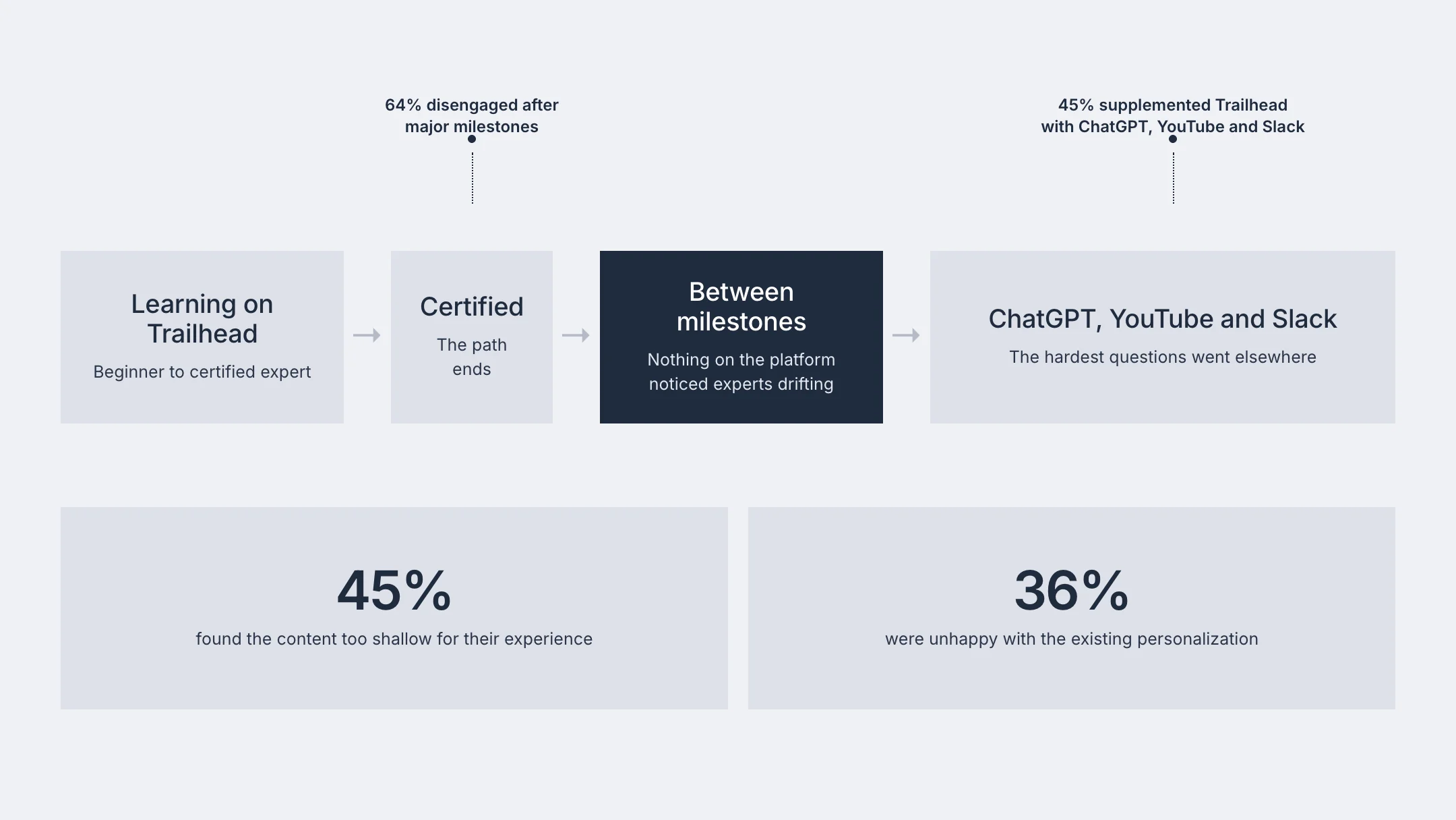
Salesforce's most experienced users were taking their questions to ChatGPT and Slack instead of Trailhead's own community, and between milestones, nothing gave them a reason to come back.
Solution: Answers, plus prompts.
Plain-language answers to real Salesforce problems inside Trailhead, paired with proactive prompts that surface what's relevant next without being asked.
Outcome: 6/8
Given the same Salesforce question, 6 of 8 power users preferred Solve over ChatGPT.
RoleProduct designer on a team of five, working inside Trailhead's product team.
The research, the prototype and the media were shared work. We designed in Figma against Trailhead's design system, then took it into working software with Figma MCP, Cursor and Claude Code, so each of us could test what we designed.
Product Designer (Apprentice)
Conversational UX, RAG workflows, power-user research and dashboard design.
A team of five
Worked alongside the Salesforce Trailhead product team.
Design to working code
Figma, Figma MCP, Cursor and Claude Code, wired to OpenAI.
02Problem
The certification path ended, and ChatGPT caught experts on the way out.
Experts weren't churning in anger. They were quietly drifting, and nothing on the platform noticed. Engagement fell exactly where certification ended, and experts took their hardest questions to ChatGPT. The question we carried into every decision: how might Trailhead become the first place an expert goes when they're stuck, not only when they're studying?
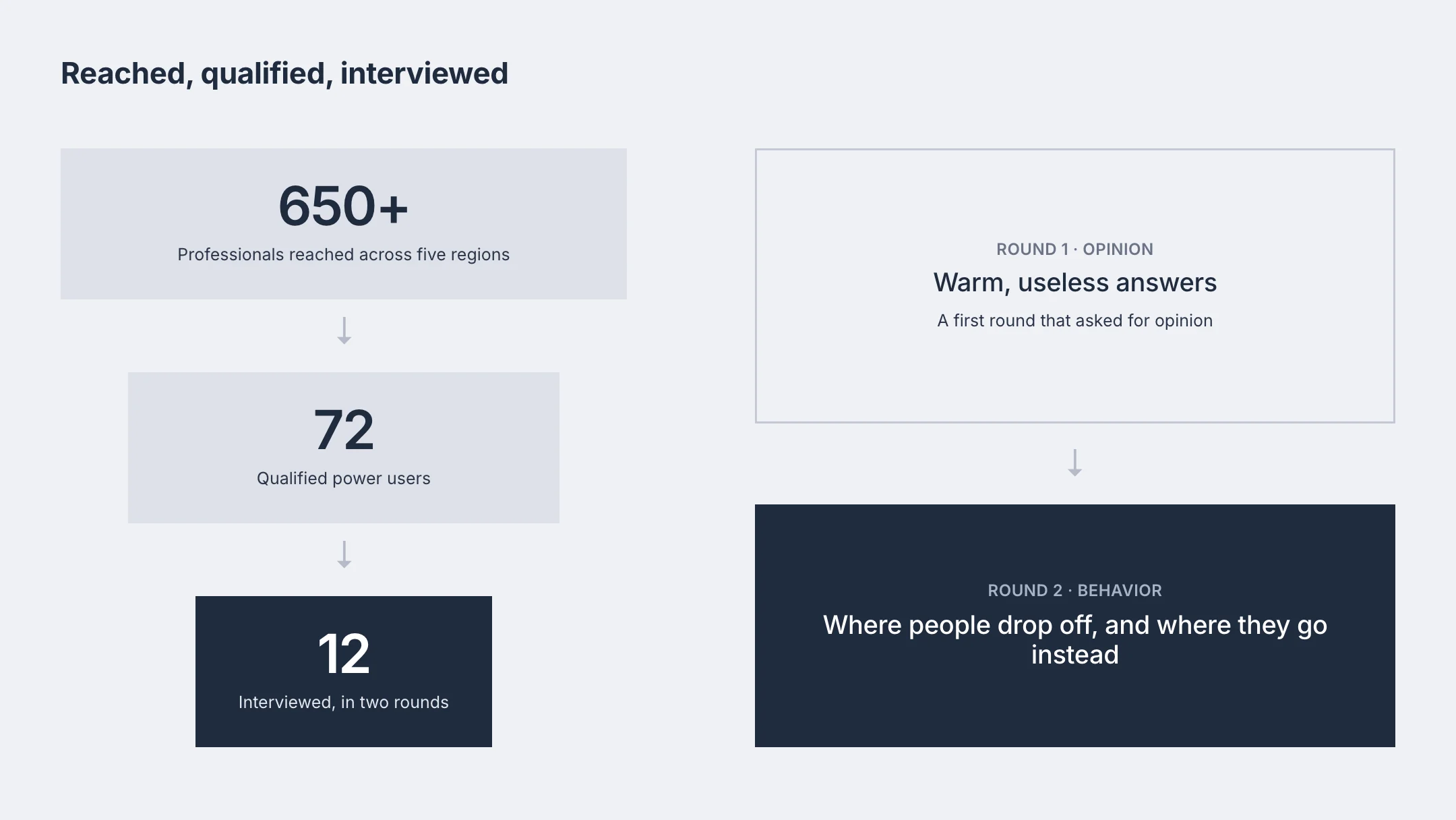
UsersWe reached 650+ power users and asked where they go instead.
A first round on opinion gave warm, useless answers, so we switched to behavior: where people drop off and where they go instead.
Alex, the Architect · Confident Amplifier
Opens ChatGPT first when a real problem hits. Certifications are tied to billing rates and performance reviews.
Jenny, the Developer · Focused Professional
Certifications are tied to reviews. Pauses under workload and finds no clear way back in.
03Hypothesis
Catch the ChatGPT moment, and experts come back.
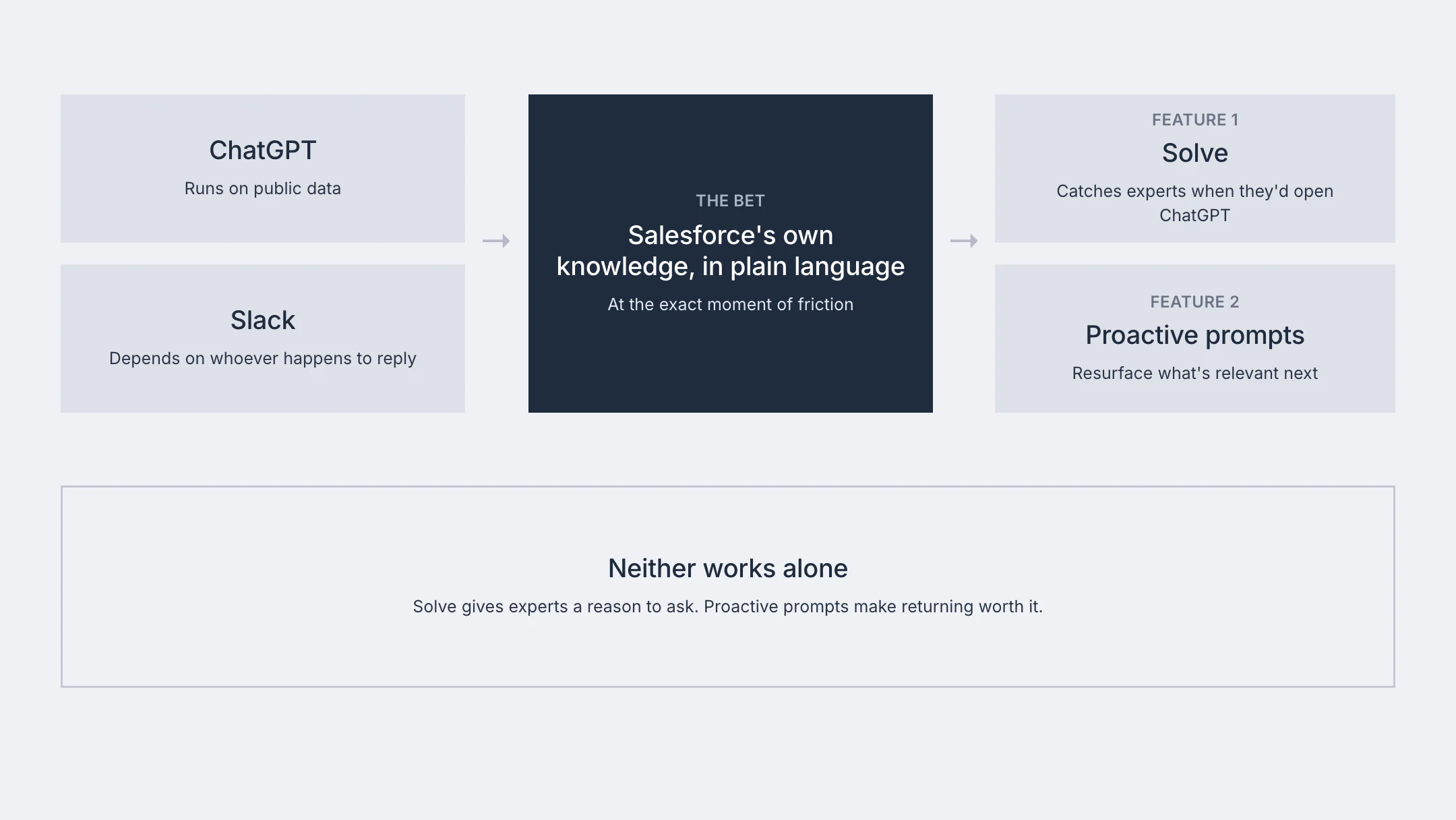
If Trailhead answers an expert's hardest question at the moment they would otherwise open ChatGPT, and gives them a reason to return between milestones, it can become the first place they go when they are stuck.
ConstraintsPublic documentation only, a brand that can't be faked, and eight real experts.
We built on OpenAI with curated public documentation and focused on proving the experience. Power users were scarce, so how we tested mattered as much as what we built.
Success metric
Preference over ChatGPT on a real question, confidence in the answer, and completion of the prototype task.
Guardrail
Protect Trailhead's warm, human brand. No AI speaking on behalf of a real person.
Limits: data and people
Curated public documentation, not Salesforce's proprietary data or Agentforce, and only 8 real power users.
04Solution
Kill two ideas on purpose, then ship the bet that held.
Kill the ideas that don't hold, ship the two features that do, then test them as working software instead of a slideshow.
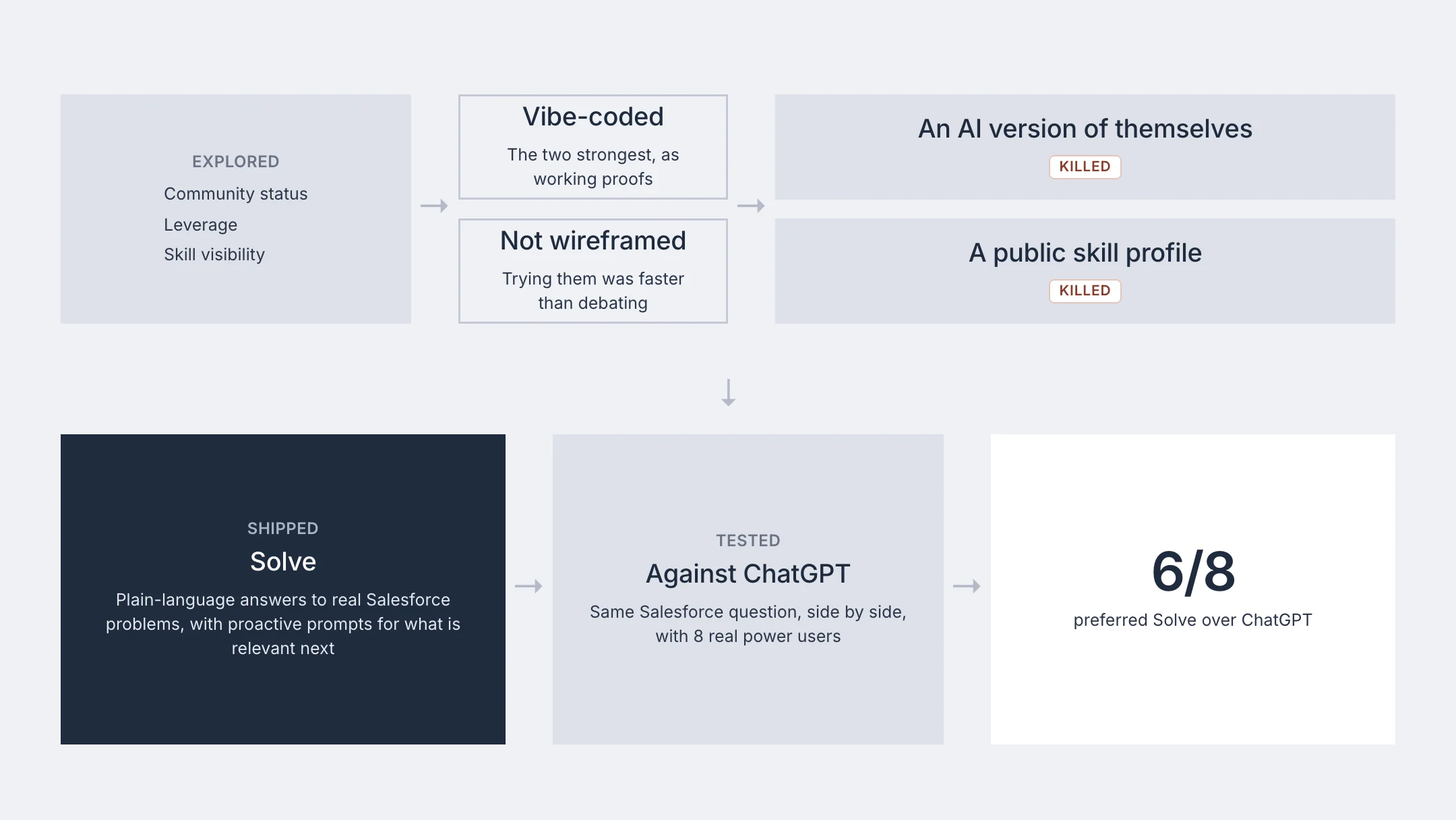
What we killedTwo ideas we built on purpose, so the real bet had room.
We explored community status, leverage and skill visibility, then skipped wireframes and vibe-coded the two strongest into working proofs of concept. Trying them ourselves was faster than debating them.
What we shippedCatch the ChatGPT moment, then give experts a reason to come back.
Solve catches power users at the moment they would otherwise open ChatGPT; proactive prompts make returning worth it.
01 · Solve: A plain-language answer, calibrated to you
Ask in plain language
A specific, actionable answer that cites Salesforce documentation.
Set the depth
Beginner, Intermediate or Advanced, so you are never over-explained or underserved.
Never a dead end
When Solve can't fully help, it drafts a ready-to-post Trailblazer Community question from your conversation.
02 · Proactive prompts: The platform does the noticing
Renewals
Flags a certification renewal before it lapses, closing a notification gap users complained about.
Skill gaps
Measures a skill profile against what the market is hiring for and builds a path to close the gap.
Follow-ups
Reads the questions asked in Solve and recommends what to learn next.
Build & testWorking software and synthetic users before we spent real people's time.
Each component was designed in Figma against Trailhead's design system, then taken through Figma MCP into Cursor and Claude Code and wired to OpenAI. No handoff, no rebuild from a spec: a working app, so we could test it like a product instead of a slideshow.
Real power users were scarce, so we turned our research into 12 AI agents and ran them through the flows first. By the time 8 real power users arrived, the obvious rough edges were gone and their time went to what needed a person.
What was running
React front end, Express and SQLite back end, OpenAI for responses, voice input, expertise calibration and community-post drafting.
12 agents, then 8 users
Synthetic users built from research data caught usability problems before real sessions.
05Learning
Preferred over ChatGPT in a small prototype test, with honest limits on what we proved.
The honest limit: curated public documentation, not Salesforce's proprietary data or Agentforce, and 8 power users. The next step is a larger test on real support data, where the bet can be proven at scale.
6/8 preferred Solve over ChatGPT
Same Salesforce question, side by side.
4.5/5 confidence
In Solve's answers.
8 users
A directional prototype study, not a scaled product metric.
Public-doc RAG
Useful for experience testing, not proof of enterprise answer quality.
“I had never been comfortable in code, and had never prototyped with it, so teaching myself to ship this as working software is the barrier I'm proudest of clearing.”
LearningThe hardest part was finding authentic power users.
What worked
Designing for users who'd already arrived gave every decision a clean test.
What was hard
Recruiting authentic power users on a semester timeline.
What's next
Scale testing globally, refine Solve's answer quality, and pitch a formal roadmap.
“Power users don't disengage because Trailhead runs out of content. They disengage because it stops speaking to who they've become.”